
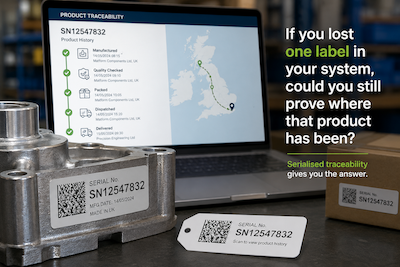
If you lost one label in your system, could you still prove where that product has been?
Most businesses assume the answer is yes.
Until an audit, a recall, or a missing scan proves otherwise.
In modern manufacturing and logistics, traceability isn’t just about tracking products — it’s about being able to prove identity at every stage of the journey.
And that’s where serialisation changes everything.
Serialisation is not just labelling
Serial number labels are often treated as a “print requirement”.
In reality, they are a data anchor.
Each label represents a unique identity — one item, one code, one traceable history.
No duplicates. No ambiguity. No assumptions.
When built properly, serialisation connects physical products to digital systems across production, storage, distribution and use.
The problem most businesses don’t see
Traceability failures rarely happen because “there are no labels”.
They happen because:
- labels become unreadable
- data is inconsistent across systems
- tracking is fragmented between departments
- environments destroy label integrity over time
The result?
A system that looks compliant — until it is tested.
Why serial number labels matter more than ever
Modern supply chains don’t tolerate gaps.
Serialised labelling enables:
- Item-level traceability across the full lifecycle
- Faster and more accurate recalls
- Reliable audit trails
- Reduced manual tracking errors
- Greater control in regulated environments
But the real value isn’t the label itself.
It’s the continuity of information it supports.
It’s not a labelling problem — it’s a systems problem
One of the biggest misconceptions in industry is that traceability is a print issue.
It isn’t.
It’s a system design issue.
A serial number label is only effective if:
- it remains readable in real-world conditions
- it integrates with digital tracking systems
- it survives handling, storage and environmental stress
- it is consistently applied across operations
When any of these fail, traceability becomes fragmented.
Where things usually break down
In most operations, traceability gaps appear in predictable places:
- warehouse handling
- environmental exposure (heat, cold, chemicals)
- manual data entry points
- mixed labelling standards across sites
The weakest link is rarely the technology — it’s consistency.
What good serialisation actually achieves
When done properly, serial number labelling creates:
- a single source of truth per item
- full visibility across the supply chain
- instant verification at any stage
- confidence during audits and compliance checks
It turns traceability from a reactive process into a controlled system.
Final thought
Traceability doesn’t fail when a product moves.
It fails when identity becomes unclear.
Serial number labels don’t just identify items — they protect the continuity of information that modern operations depend on.
And in industries where one missing record can mean a failed audit or a delayed recall, that continuity is everything.